
Mastercard (The Compounder Score)
The boring compounder which is being overlooked by the market's AI rush...

I applied The Compounder Score, a weighted framework for assessing companies’ fundamentals, as a preliminary screening tool to determine if Mastercard ($MA) warrants a full deep-dive analysis.
The maximum score is 22 and the ranking system is as follows:
12 and below: High Risk/Pass
13 to 15: Viable
16 to 18: High Conviction
19 and above: Best-in-Class
The Compounder Score
Mastercard is part of the world’s largest duopoly, connecting millions of consumers to their banks every time a card transaction takes place.
The company owns the infrastructure required for verifying bank approval, routing them back to merchants, and ensuring that money flows correctly.
Mastercard earns a fee on every transaction it processes, creating a highly scalable business model with significant operating leverage, as it costs nothing to serve an additional customer.
Additionally, through its Value-Added Services and Solutions segment, which is growing faster and carries higher margins, it offers data analytics, consulting, fraud, and cybersecurity tools, among other solutions sold to banks and merchants.
This business offers the unique opportunity to own a growing leader embedded in one of the most powerful secular trends, the shift towards digital payments.
When this is combined with an asset-light business model which generates strong Free Cash Flow, and benefits from a wide moat, it becomes clear why Mastercard has become one of the most attractive companies for long-term investors to own.

Let’s analyze the company by using The Compounder Score:
1. Management Importance
“Skin in the Game” and Incentives: (1/2)
According to the company’s SimplyWallSt, individual insiders account for ~0.03% of the total ownership, which represents ~$130 million.
Typically, ~70% of the compensation of Mastercard’s CEO and NEOs comes from stock and option awards, with an additional strong non-equity incentive.
This could be classified as having Skin in the Game, but to ensure full alignment with shareholders, insider ownership should be much higher.
Business Resilience to Management: (1/1)
Since Mastercard was founded in 1966, it has had 3 CEOs, with Michael Miebach taking over in 2021.
The successful transition between CEOs without operational disruption has proven that the business is resilient to leadership changes.
Additionally, since Mastercard’s business model is so deeply embedded in the global financial infrastructure that it is widely considered part of a duopoly, the company is likely to generate substantial profits regardless of its management.
2. Market Dynamics
Large and Growing TAM: (1/1)
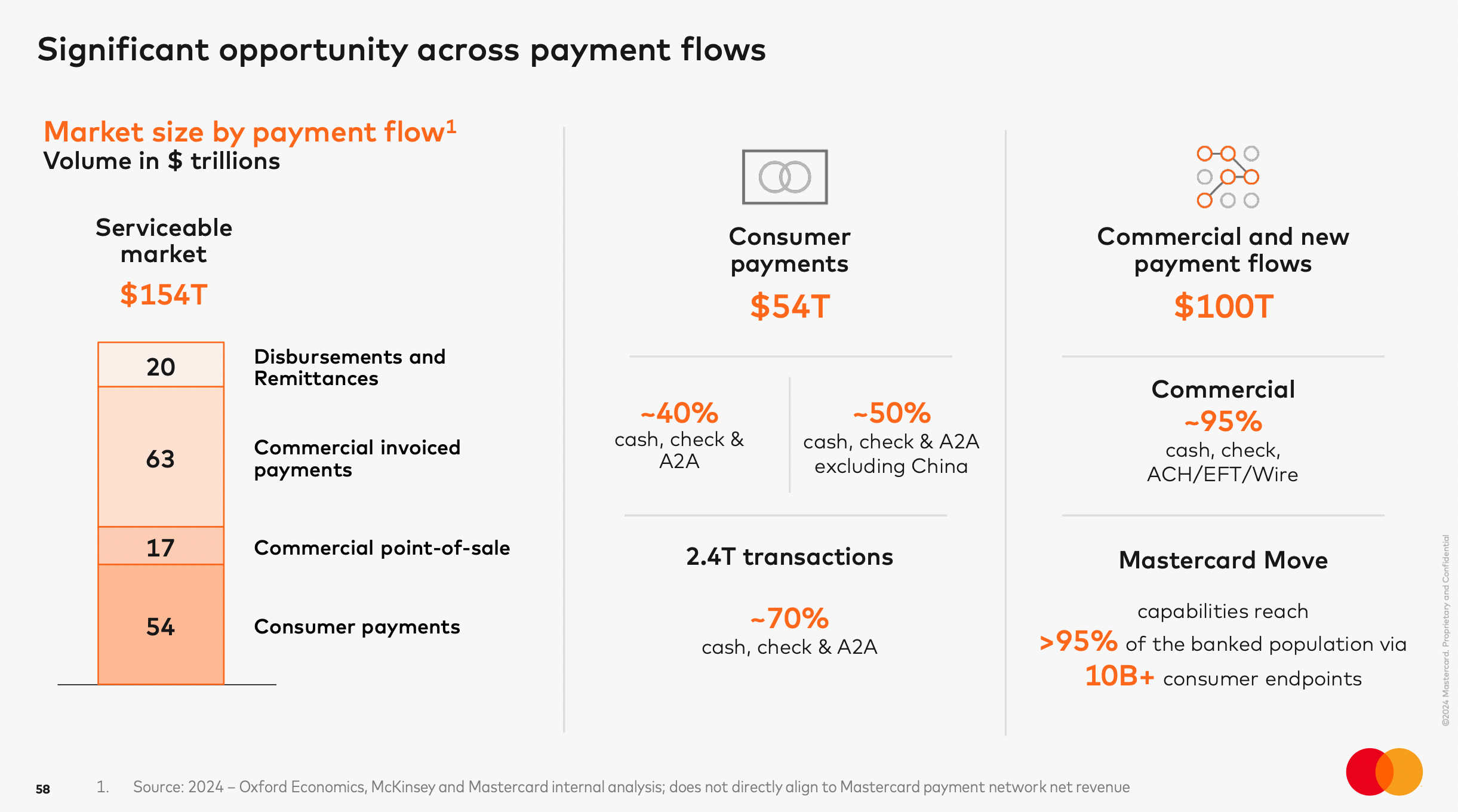
MA 0.00%↑ estimates their SAM as the worldwide total payment flow, including consumer payments and commercial payment flows, which adds up to ~$154 trillion.
Despite significant competition, this represents that the company still has a large room for future growth in these segments.
Moreover, the recent focus on value-added services represents an additional, higher-margin growth lever, where Mastercard has only penetrated 7% of the market, according to internal reports.
Exposure to Secular Trends: (1/1)
Intuitive Surgical’s offerings benefit from several powerful secular trends:
Shift to Electronic Payments: Cash still represents the majority of global payment transactions, particularly in emerging markets (EMs)
E-Commerce Growth: Rapid growth in online shopping, which is only possible with digital payment infrastructure
Financial Inclusion in EMs: Hundreds of millions of adults remain underbanked in Africa, Southeast Asia, and Latin America
Data-Driven Security: Fraud and digital crime are becoming increasingly sophisticated, raising demand for security, identity verification, and real-time fraud detection solutions
3. Business Model
Asset-Light Model: (1/1)
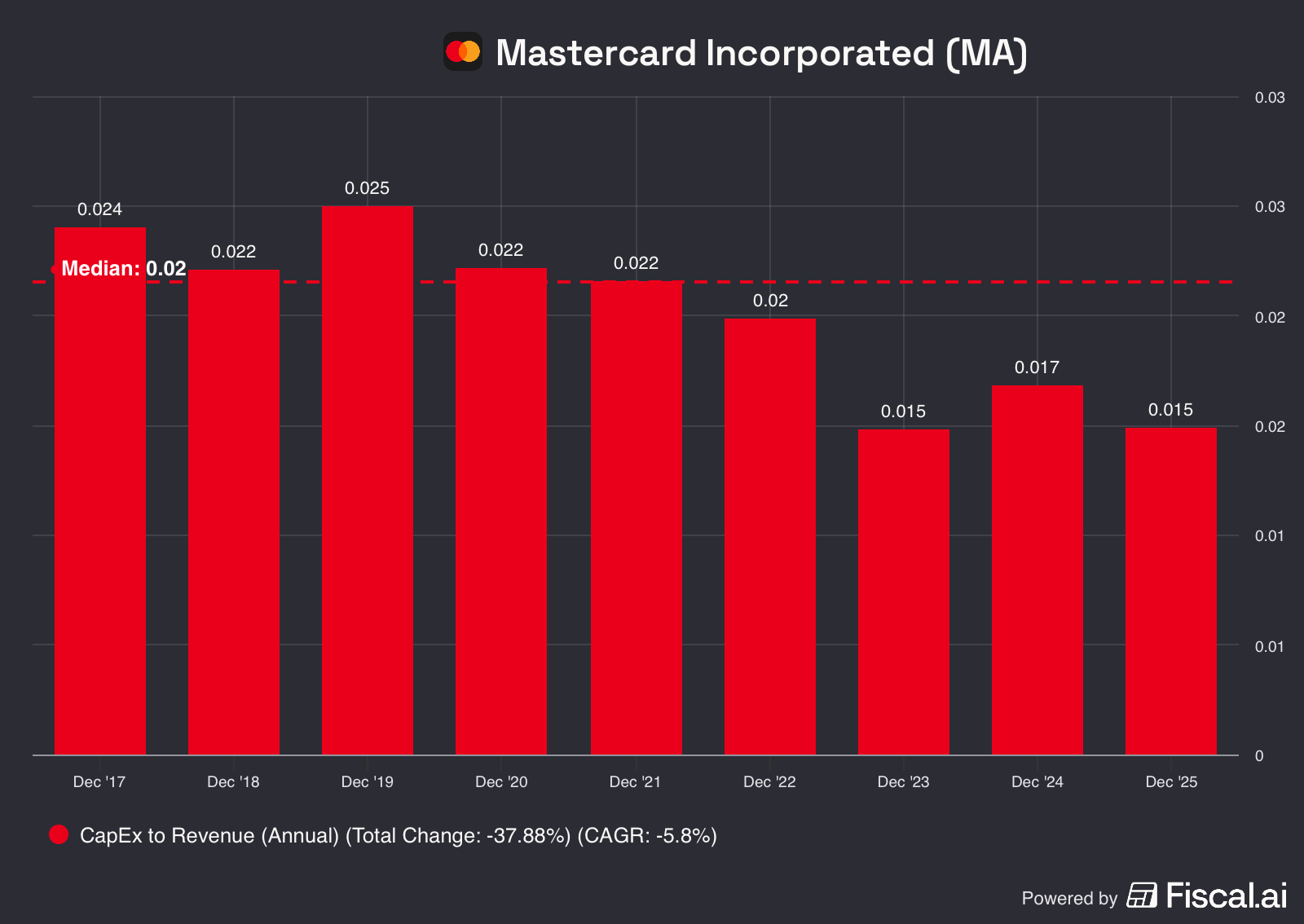
MA 0.00%↑ has maintained a CAPEX ratio below 2% of its revenue for the past 9 years, with a 9-year median of 2%, allowing them to be considered an asset-light business.
High Portion of Recurring Revenue: (1/1)
Even though Mastercard’s major revenue source does not operate through a subscription model, its embeddedness into consumer’s daily lives allows them to enjoy a high portion of recurring revenue:
Recurring Revenue (~60% of total revenues): Mastercard processes over 400 million transactions each day, receiving a small commission on every single one of them. As long as people continue to spend via credit cards, Mastercard will continue to earn fees.
Subscription Revenue (~20% of total revenues): Includes multi-year contracts with banks for fraud detection, data analytics, and other services with low churn rates.
Margin Stability / Growth: (1/2)
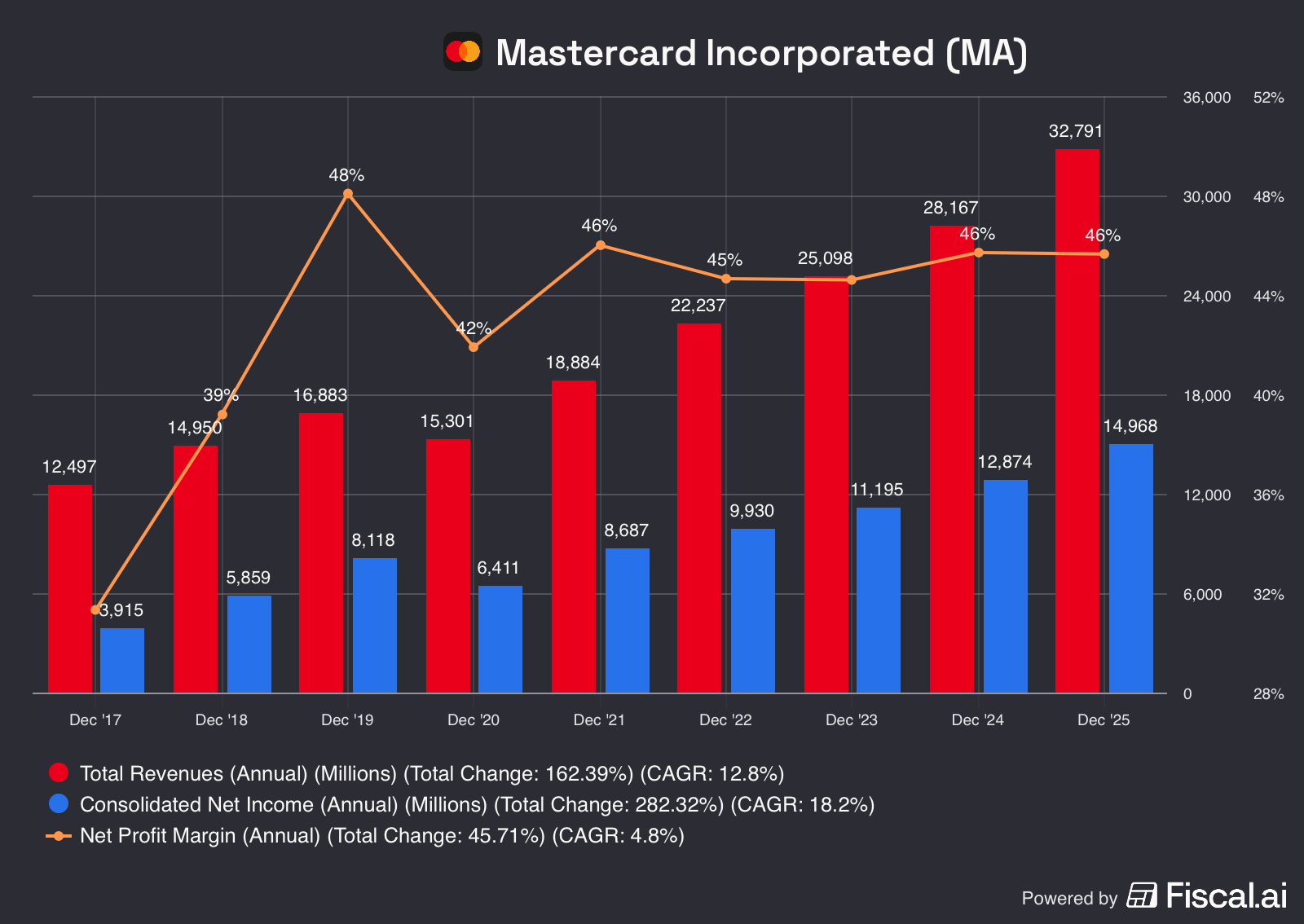
Mastercard’s margins have remained constant, ranging between 42% and 48% for the past 7 years.
However, these margins are not expected to rise in the future, with antitrust lawsuits having emerged due to the company’s incredibly consistent profitability.
4. Economic Moat
Sustainable Competitive Advantage: (2/2)
MA 0.00%↑ is mainly protected by its Network Effect and its Scale Advantage.
Mastercard being accepted by almost every merchant in the world makes it the default choice for any consumer looking to obtain a payment card to make digital payments.
To displace Mastercard, a new entrant would need to convince its clients to switch, which would require a similar widespread acceptance by merchants.
Moreover, since the company has already developed their payment processing infrastructure, it does not incur additional costs from new clients joining its services.
This, combined with their massive scale allows MA 0.00%↑ to have a cost per customer which cannot be matched by any competitor, apart from Visa.
On our Hierarchical Level framework, Mastercard achieves a Tier 2 (Ecosystem Moat) rating, as it meets the following litmus.
“Is the cost of leaving this company higher than the cost of staying with them, even if a competitor is 20% cheaper?” - Tier 2 Moat Litmus
Even though the company owns multiple assets which cannot be replicated, like their infrastructure and their client and merchant base, it faces competition from companies like Visa and American Express, enabling us to assign a Tier 2 (Ecosystem Moat) rating to Mastercard.
![Visa vs. Amex vs. Mastercard [Differences, Acceptance & Perks]](https://substackcdn.com/image/fetch/$s_!XHVv!,f_auto,q_auto:good,fl_progressive:steep/https%3A%2F%2Fsubstack-post-media.s3.amazonaws.com%2Fpublic%2Fimages%2F06470bb7-0f65-4029-879c-08d9ef58f0ae_3000x1688.jpeg "Visa vs. Amex vs. Mastercard [Differences, Acceptance & Perks]")
Pricing Power: (0.5/1)
Mastercard is not able to increase its prices at a faster pace than inflation without losing customers for a sustained time period, as its revenue mainly comes from commissions where the take rate cannot be increased continuously.
However, this business model allows it to capitalize from merchants raising prices, allowing them to benefit from inflationary pressures.
On the other hand, its rapidly expanding Value-Added Services segment does enjoy pricing power, exercised during contract renegotiations.
Dominant or Disruptive Position: (1/1)
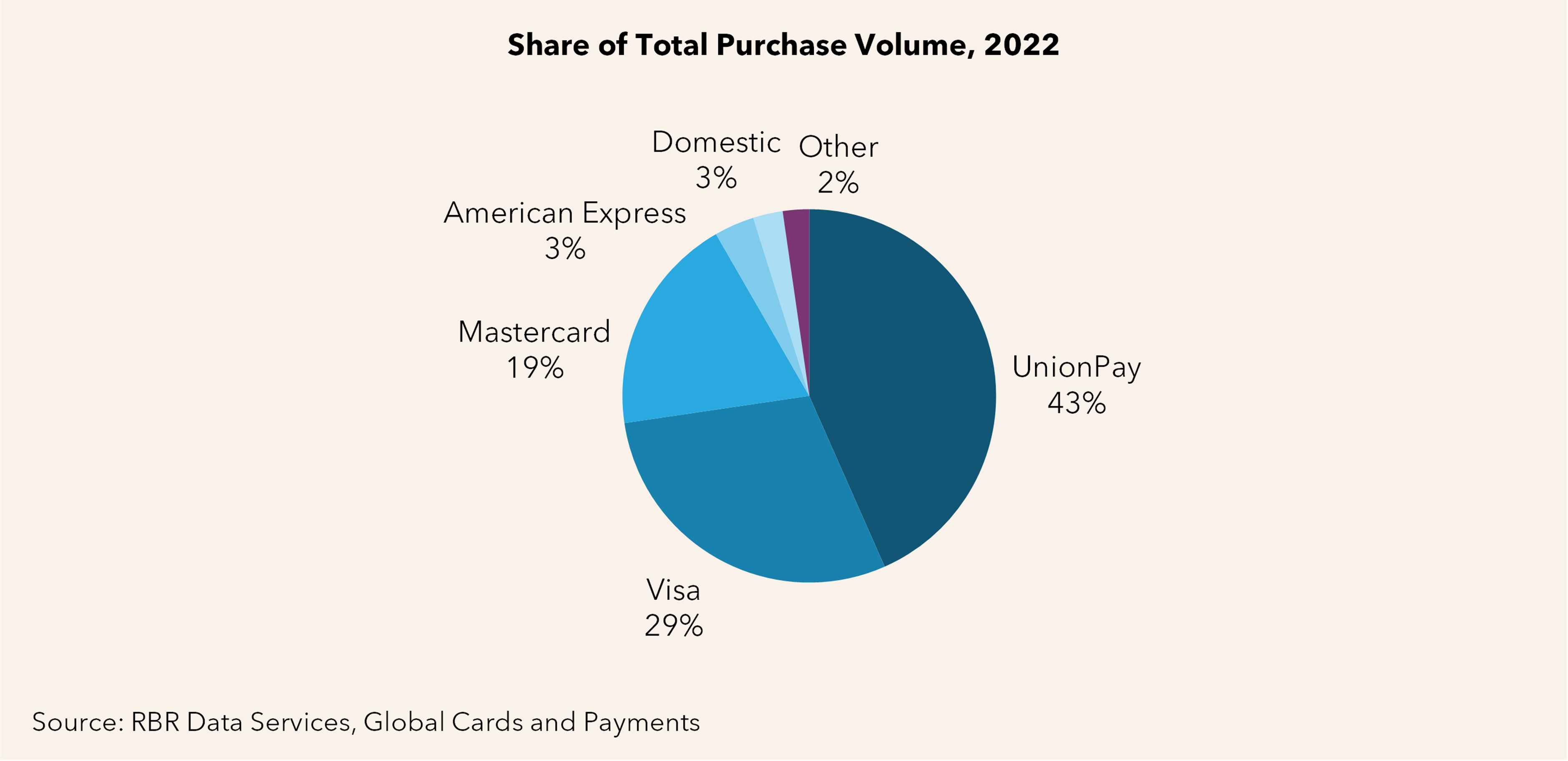
Mastercard is a clearly dominant player in the payment network segment, enjoying a ~19% global market share, which rises to ~40% when excluding Southeast Asia.
Additionally, the company is investing heavily into new disruptive technologies, having acquired BVNK to position itself as a leader in stable-coin payments.
Embedded in Customer Behavior: (1/1)
Mastercard’s products are deeply embedded in the daily lives of most people as payment cards are often the only payment type used by consumers.
Their services have become automatic, with consumers relying on its services through habitual usage, without having to worry about which payment network processes their transaction.
5. Financial Analysis
ROCE: (2/2)
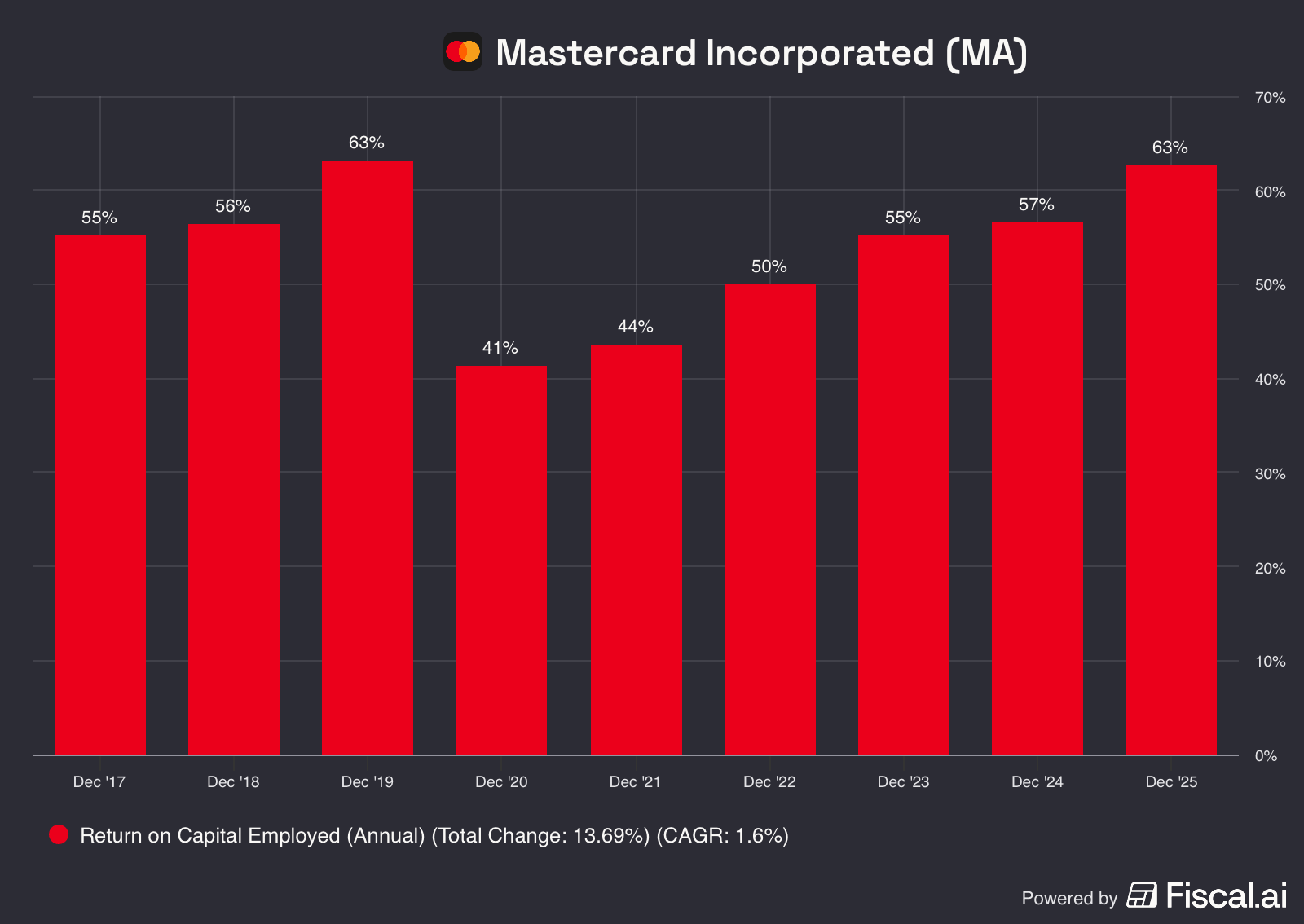
MA 0.00%↑ has had an average ROCE of 54% over the past 5 years.
The company has achieved a ROCE above our threshold of 15% every single year we can analyze, currently at a 63%.
Since the typical cost of capital, WACC, for mature companies ranges between 7%-12%, this suggests that Mastercard is generating significant value for shareholders.
Free Cash Flow Consistency: (1/1)
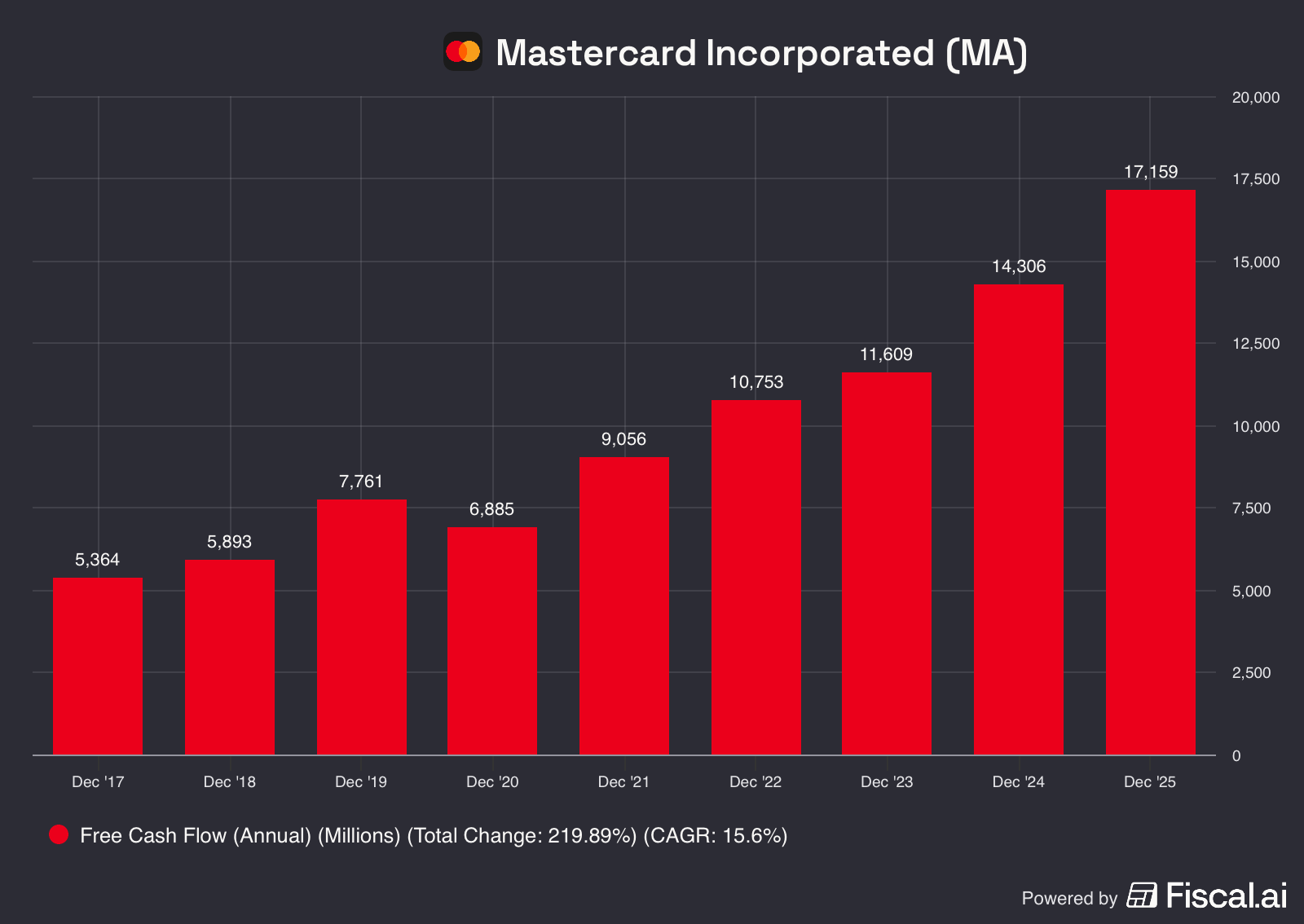
Mastercard is able to generate highly predictable FCF every year, which is evident as most of their represent an improvement from the prior results.
The company generated $17.2 billion in 2025, representing a ~20% YoY growth, due to its net income growth being paired with lower than expected CAPEX.
Resilience & Cyclicality: (0.5/1)
Mastercard’s business model may be considered cyclical as its revenue depends significantly on worldwide consumer spending.
However, even though discretionary spending typically decreases during economic recessions, essential purchases on groceries, utilities, or medical services will remain robust.
On the other hand, the company’s fastest growing segment (Value-Added Services) operates under multi-year contracts with large corporations, which may be considered highly resilient to economic cycles.
This cyclicality can be seen in its FCF consistency, which only fell 11% during 2020, despite there being lockdowns all around the world.
6. Growth and Profitability
Sustainable Double-Digit Growth: (1/1)
MA 0.00%↑ is estimated to achieve revenues of $53.6 billion in 2029 (TradingView).
When considering that their revenues in 2025 were $32.8 billion, this projection would indicate a 13.1% revenue growth CAGR.
This estimated growth is above the double-digit growth we would expect to see.
Growth Levers: (1/1)
Mastercard has individual levers for growth. The company's most important strategic areas are:
B2B and Commercial Payments: The digitization of B2B payment flows represents a massive, largely untapped opportunity.
Value-Added Services: Investing heavily in fraud prevention, data analytics, and cybersecurity to leverage a higher-margin segment.
Emerging Market Penetration: Targeting the unbanked and underbanked populations of Africa, South and Southeast Asia, and Latin America.
New Fintech Partnerships: Partnering with innovative players, allowing it to participate in the new ecosystem rather than being disrupted by it.
Pathway to Profitability: (2/2)
Mastercard has been profitable since before its 2006 IPO and has since been expanding its margins.
7. Red Flags and Risks
Lack of an Economic Moat: (0/-2)
Mastercard has a Tier 2 (Ecosystem Moat) rating based on its Network Effect and Scale Advantage.
Balance Sheet Risk: (0/-2)
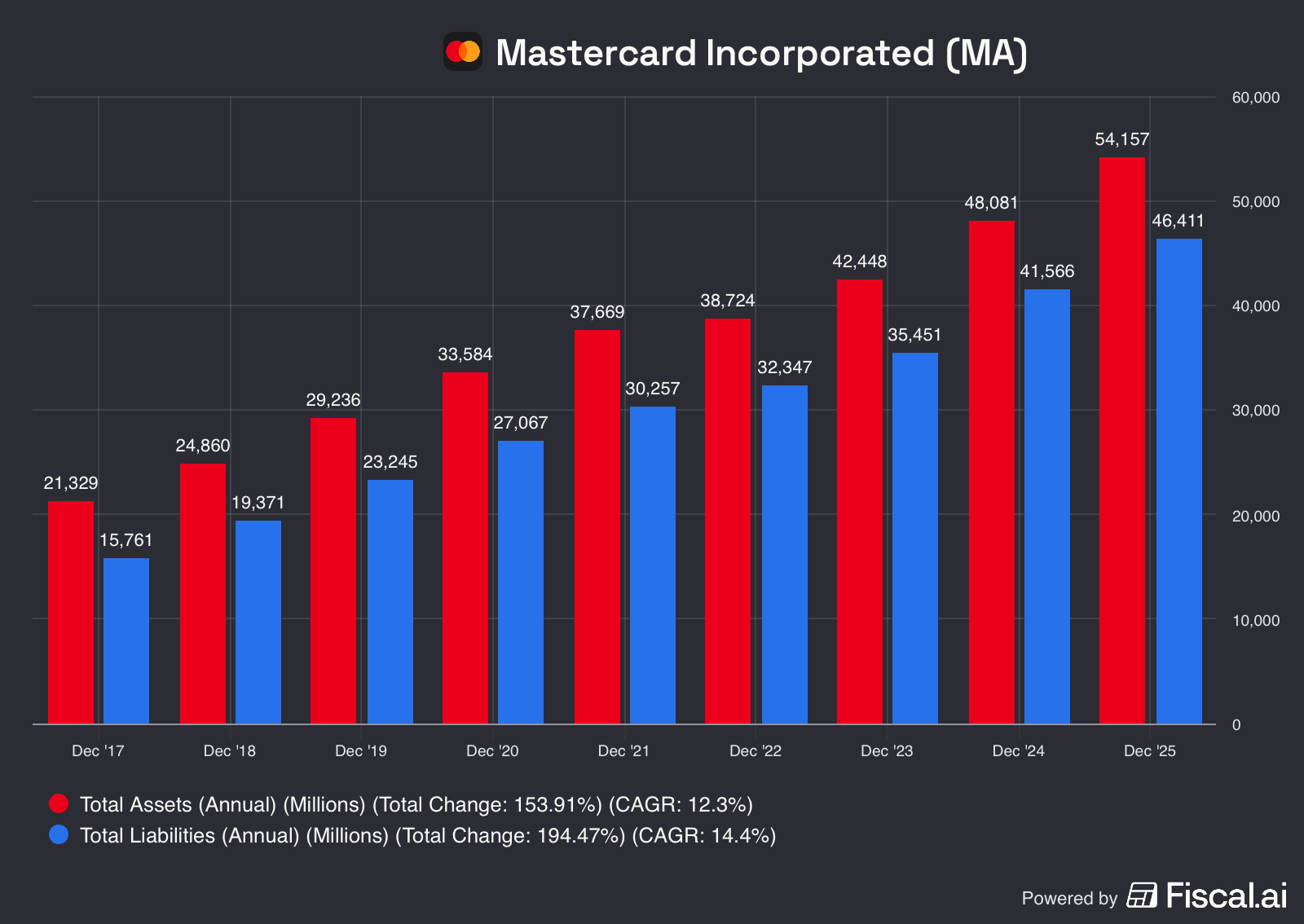
Mastercard’s balance sheet is incredibly solid. As of December 2025 its current assets were $54.2 billion, while its total liabilities amounted to $46.4 billion.
Lack of Profit Visibility: (0/-2)
Mastercard has been profitable since before its 2006 IPO and has since been expanding its margins.
Regulatory & Geopolitical Risk: (-0.5/-1)
As with any global payment network, Mastercard is highly sensitive to regulatory risks.
The transaction fees and network charges have caused for major antitrust lawsuits for anti-competitive rates.
On the other hand, due to their presence in over 210 countries, the company is significantly exposed to geopolitical events like wars, and international sanctions (as seen with Russia).
Core Business Disruption: (-0.5/-1)
There is a market wide perception that Mastercard’s long-term dominance is threatened by new technology like digital currencies.
However, since the company was founded in 1966, it has shown its ability to adapt to new technologies to maintain its market share (integrating with Apple Pay, buy-now-pay-later providers, and fintech platforms).
Having said that, investors should still be wary of developments in EU’s Wero wallet or Fintech developments which aim to displace Visa’s and Mastercard’s duopoly.
Customer Concentration Risk: (0/-1)
Mastercard does not have a customer concentration risk as its revenue is generated from hundreds of millions of customers all around the world.
“Mastercard did not have any individual customer that generated greater than 10% of net revenue in 2025, 2024 or 2023.” - Mastercard’s 2025 Annual Report
Share Dilution: (0/-1)
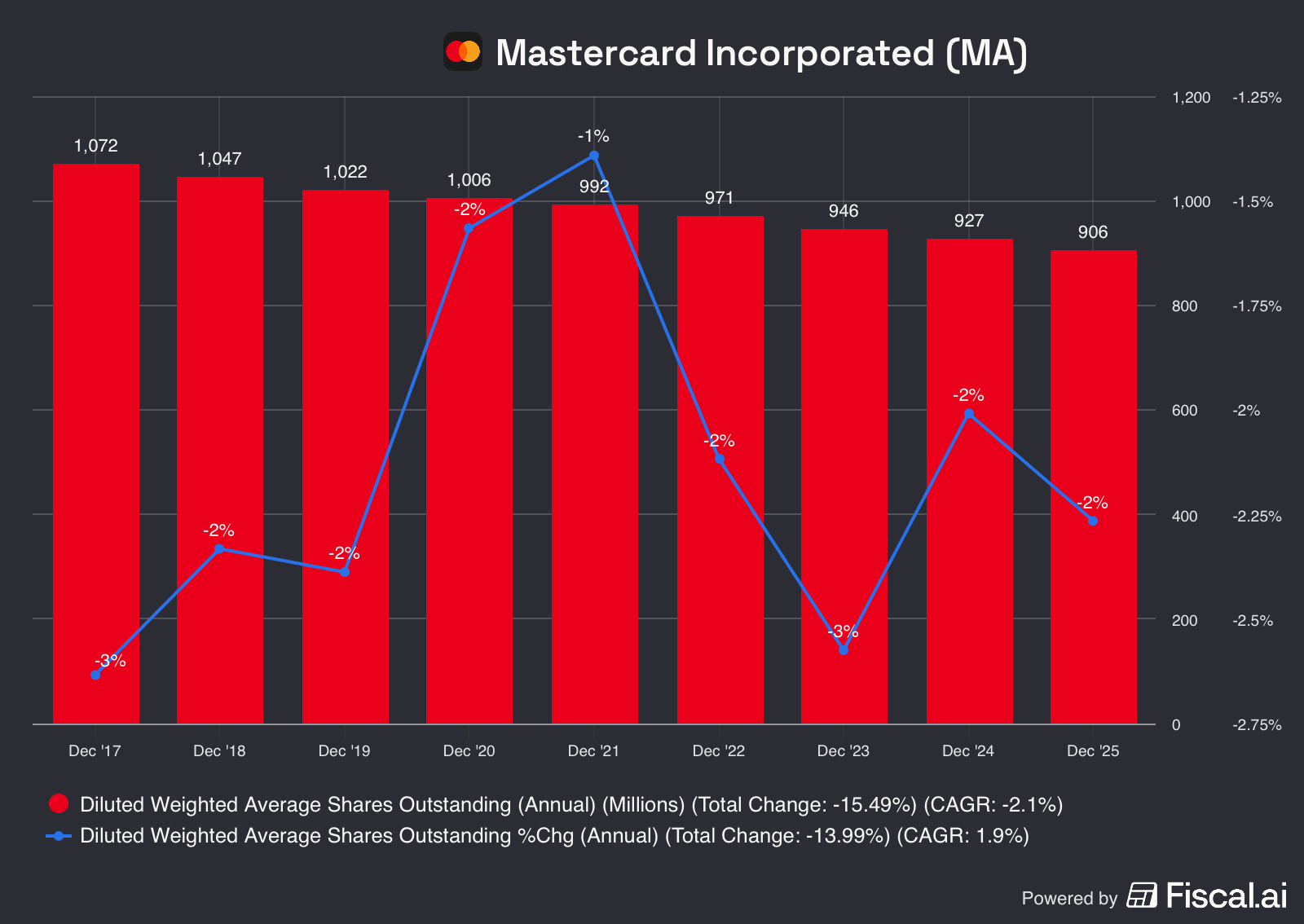
Mastercard’s total shares outstanding have been decreasing every single year since 2017, evolving from 1,072 million to 906 million shares outstanding, a 15.5% decrease in 9 years.
This acts as an organic tailwind on EPS, as every fiscal year the company’s earnings may be distributed among fewer shares.
Mastercard Quality Score (FINAL):
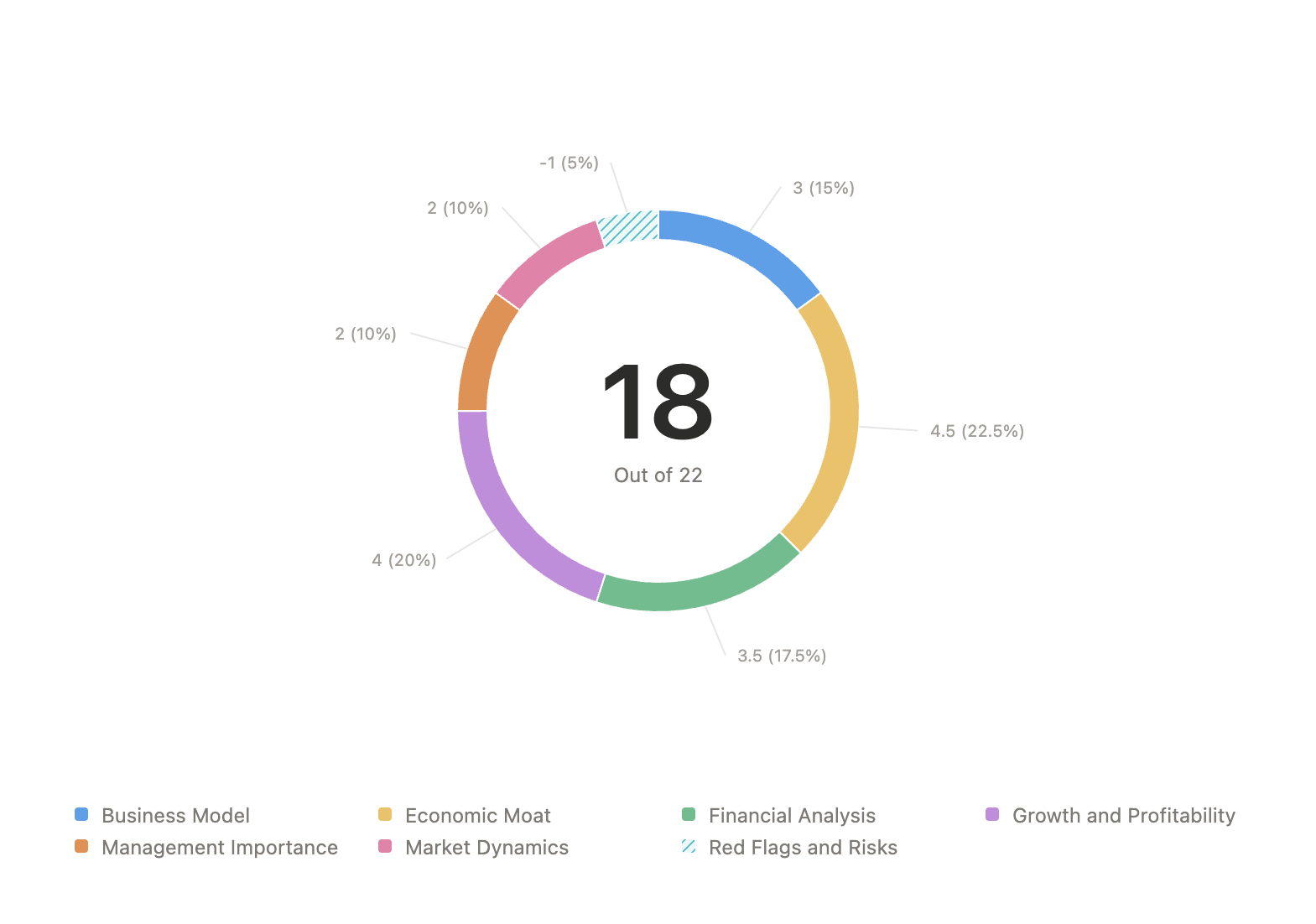
Adding up the scores and deducting one for potential risk, Mastercard scores a total of 18/22 points, making it a “High Conviction” business.
Please leave a like if you enjoyed this post and found it valuable!
We have reviewed Mastercard’s fundamentals utilizing our proprietary framework, The Compounder Score. However, does this mean that the stock is trading at a valuation where it should be deemed a clear buy or is the risk too high?
The final, essential sections cover:
Comparable Analysis of MA’s historic valuation ratios versus its peers.
The Compounder DCF with potential return and intrinsic value estimates based on scenarios.
This part of the analysis is reserved exclusively for our premium subscribers to reward for their amazing support.
Subscribe now to get full access to all our upcoming analyses!
Mastercard’s Valuation:
